Engineering Deep-Dive: Dismantling Monolithic PHP Debt with Whoobe’s Zero-SQL TypeScript Architecture
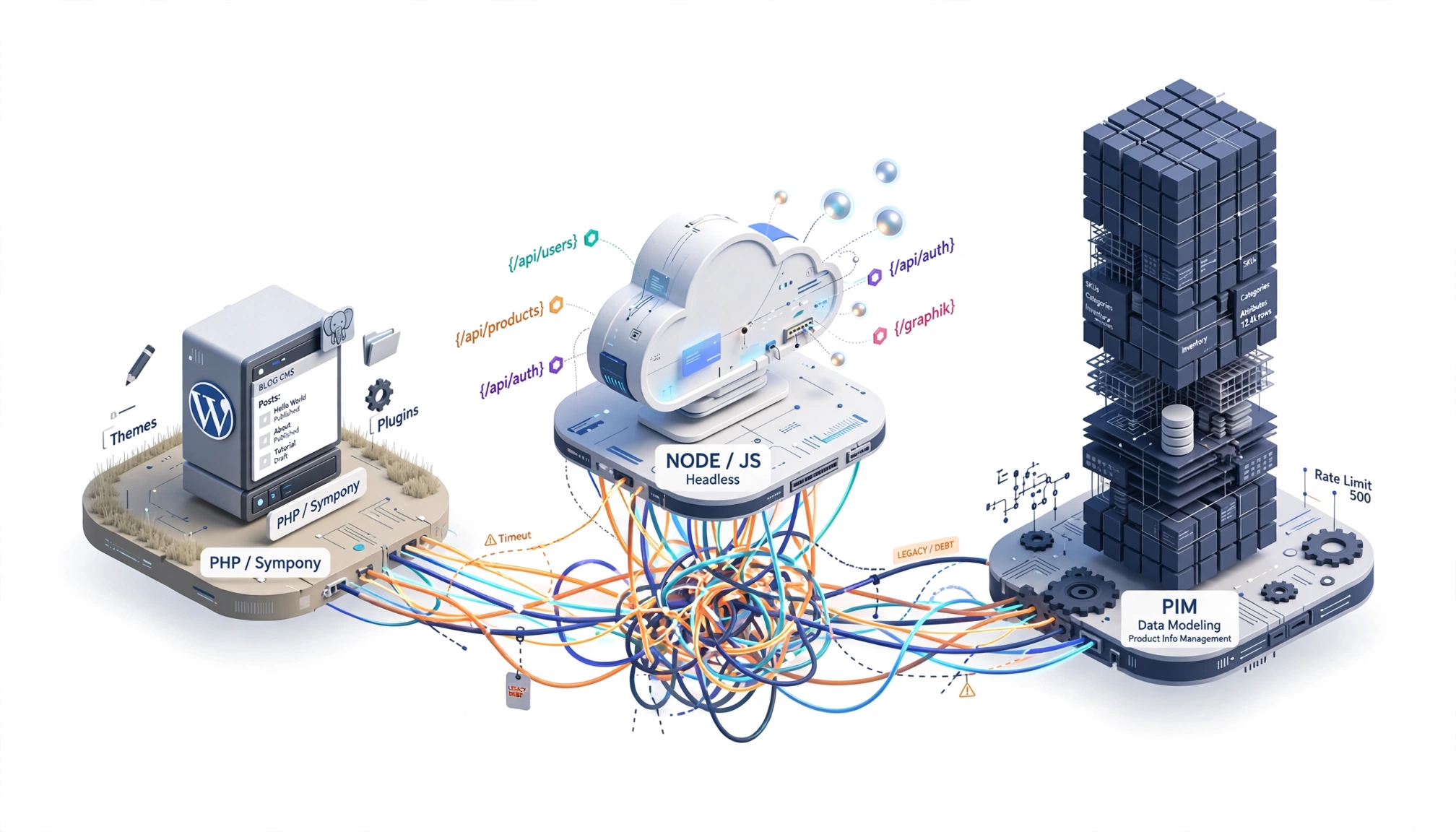
An architectural breakdown of how Whoobe leverages a unified TypeScript stack, PostgreSQL JSONB, and a server-side proxy gateway to solve the infrastructure, memory, and validation constraints found in legacy enterprise PHP setups.
Enterprise data modeling and content delivery have been historically dominated by heavy PHP/Symfony or Zend frameworks, such as Pimcore, Magento, or heavily customized Drupal infrastructures. While these monolithic platforms pioneered runtime data configuration, they have inherited structural, operational, and performance anomalies that act as massive bottlenecks under high-concurrency modern workloads.
Legacy PHP setups force engineering teams into deep architectural trade-offs: continuous database DDL alterations at runtime, massive table join expansions, and fragmented communication layers between backend business logic, visual builders, and mobile viewports.
When we designed Whoobe, our open-source composite data platform, our goal was to address these constraints directly. By moving enforcement from database migrations to application runtimes, we engineered a unified TypeScript monorepo (pnpm + Turborepo) that collapses data objects (PIM), media pipelines (DAM), visual layouts (CMS), and remote system proxying into an ultra-lightweight, high-concurrency environment.
Here is a deep-dive engineering analysis of how Whoobe’s architectural choices resolve the structural scaling challenges found in legacy enterprise PHP setups.
1. Eliminating Table Explosions: The JSONB + Zod Engine
In a legacy enterprise PHP system like Pimcore, adding a field or structural object definition through the administrative user interface triggers complex server-side operations: the platform parses configuration files (var/classes/*.php), dynamically updates internal cache stores, and executes raw SQL DDL ALTER TABLE operations to map out columns or spin up dynamic runtime tables.
At enterprise scale, this approach presents three main engineering challenges:
DDL Locks: Altering active database schemas containing millions of records during live business hours causes table locking, transaction queueing, and potential downtime.
Relational Join Explosions (EAV): To circumvent DDL locks, many platforms fall back on Entity-Attribute-Value (EAV) mapping. This forces single data lookups to branch into dozens of
LEFT JOINoperations across disconnected data tables, exhausting memory pools.Mismatched Type Systems: Data definitions live in configuration matrices, are checked by separate PHP validation code, and are then stored under distinct SQL types, creating major type safety vulnerabilities.
Whoobe bypasses relational data fragmentation by leveraging PostgreSQL 16 binary JSON blocks (JSONB) coupled with application-level Zod schemas.
// apps/core/src/validation/schema-compiler.ts
// Whoobe dynamically compiles UI class definitions into runtime Zod guards
export function compileClassValidator(classDefinition: any) {
  return z.object({
    sku: z.string().min(1),
    locales: z.record(
      z.string(), // e.g., 'en', 'it', 'tr'
      z.object({
        name: z.string(),
        description: z.string(),
        attributes: z.record(z.string(), z.any())
      })
    ),
    logistics: z.object({
      total_stock: z.number().nonnegative(),
      warehouses: z.array(z.object({ id: z.string(), available: z.number() }))
    })
  });
}
Why this scales:
- Zero DDL Operations at Runtime: When a data class is modified via Whoobe’s Vue 3 administrative board, the updated schema is instantly saved as a declarative configuration blueprint. The underlying PostgreSQL data table schema remains completely unchanged.
- Application-Level Structural Guards: Data parsing, array structural checks, and multi-locale language objects are fully validated by the fast Node.js runtime environment before hitting the database.
- GIN Indexing vs Join Explosions: Instead of querying across fragmented rows, Whoobe utilizes a Generalized Inverted Index (GIN) across the unified JSONB document field. This enables Postgres to traverse nested key structures (such as nested arrays of logistical items) instantly within a single indexed record, eliminating SQL join inflation.
2. High Concurrency: Event-Loop vs Process-per-Request
Legacy PHP setups scale horizontally by wrapping their execution pipeline inside an Apache or Nginx worker pool (FPM - FastCGI Process Manager). In this classical architecture, every single incoming HTTP request blocks an entire system process.
If an application executes slow I/O actions—such as pulling a product stock status from a legacy external ERP or fetching a media asset—the PHP process sits idle in memory, blocking subsequent requests. Under heavy real-time traffic or massive web/mobile API spikes, this model leads to severe memory exhaustion.
Whoobe’s services—isolated as distinct containers (core-api and gateway)—are built natively on top of Node.js's asynchronous, non-blocking event-driven architecture.
// apps/gateway/src/proxy/rest-handler.ts
// Asynchronous, event-driven request forwarding without process blocking
import { Request, Response } from 'express';
import httpClient from '../utils/http';

export async function proxyGatewayRequest(req: Request, res: Response) {
  try {
    // Non-blocking I/O execution: the single thread remains free for other events
    const remoteResponse = await httpClient.request({
      method: req.method,
      url: `${req.context.integration.baseUrl}${req.path}`,
      data: req.body,
      headers: { 'Authorization': `Bearer ${req.context.decryptedToken}` }
    });

    return res.status(remoteResponse.status).json(remoteResponse.data);
  } catch (error: any) {
    return res.status(error.response?.status || 500).json({ error: 'Gateway Routing Failure' });
  }
}
Why this scales:
- Decoupled Compute Layer: Whoobe splits application duties cleanly. Main application traffic travels through
core-api(port3003), third-party API mappings hit thegatewayproxy (port3001), and asset processing is handled byasset-processor(porta3002). If a user executes intensive media manipulation (via the server-side Sharp pipeline), the compute load is completely isolated, preventing main data transactions from being delayed. - Low Memory Footprint: Instead of spawning dozens of system processes, Whoobe orchestrates high-concurrency requests inside a single event thread, routing database queries and gateway proxies asynchronously.
3. Native Database Search Engine vs Elasticsearch Cluster Bloat
Because legacy PHP architectures struggle to read and parse nested structural fields across fragmented tables quickly, engineering teams are typically forced to deploy external search infrastructure. This requires provisioning, indexing, and maintaining dedicated Solr or OpenSearch/Elasticsearch clusters.
This introduces massive technical debt: writing synchronization workers to push data mutations from MySQL to Elasticsearch, dealing with eventual consistency and lag issues, and managing significant operational infrastructure overhead.
Whoobe completely breaks this cluster dependency by leveraging advanced relational enterprise features built directly inside PostgreSQL 16:
tsvector+ GIN Indexing: For blazing-fast Full-Text Search directly across the text properties extracted natively from the JSONB document.pg_trgm(Trigrams): To achieve native typo-tolerance, fuzzy searching, and fast type-ahead auto-completion with zero lag, pulling data straight from the primary database repository.
-- Whoobe handles search out of the box via native database trigram indexing
CREATE INDEX idx_data_objects_fuzzy_search
ON whoobe_data_objects
USING gin ((data_attributes->>'name') gin_trgm_ops);
4. Zero-Round-Trip Security Architecture
In typical visual page builders and headless systems, integration settings and remote system endpoints are often exposed to the client interface layer. When an editing dashboard or a public web application wants to communicate with an external CRM (like HubSpot) or a marketing automation platform (like Brevo), the client bundle handles the token payload or pulls full API endpoint configurations down to the browser context.
This creates severe security vulnerabilities: private tokens are exposed inside network tabs, error trackers (like Sentry) leak keys during application errors, and browser extensions can easily scrap operational credentials.
Whoobe fixes this via a strict Zero-Round-Trip Cryptographic Proxy Layer.
All third-party credentials are securely encrypted at rest via AES-256-GCM inside the Postgres backend. When administrative routes (GET/POST/PATCH) query the gateway endpoints for configuration, the internal controller passes the object through redactEndpoint():
// apps/gateway/src/utils/security.ts
// Strict Zero-Round-Trip implementation for backoffice operations
export interface GatewayEndpoint {
  id: string;
  name: string;
  targetUrl: string;
  authConfig?: Record<string, any>;
}

export function redactEndpoint(endpoint: GatewayEndpoint): Omit<GatewayEndpoint, 'authConfig'> {
  // Completely strip out the sensitive credentials object before serialization
const { authConfig, ...securePayload } = endpoint;
return securePayload;
}